


Most people probably love pottery because of the wonderful feeling of having made something with their own hands.
While I’m still working on restoring my self-developed plugins for presenting and maintaining nature photos, I’d like to take this opportunity to show you another great hobby.
I’ve been practicing pottery since the summer of 2024. Lacking a teacher, I spend a lot of time on Instagram and YouTube. And I’ve noticed that almost no one uses anything besides loops and iron tools that looks individual.
Scrapers – or peeling irons
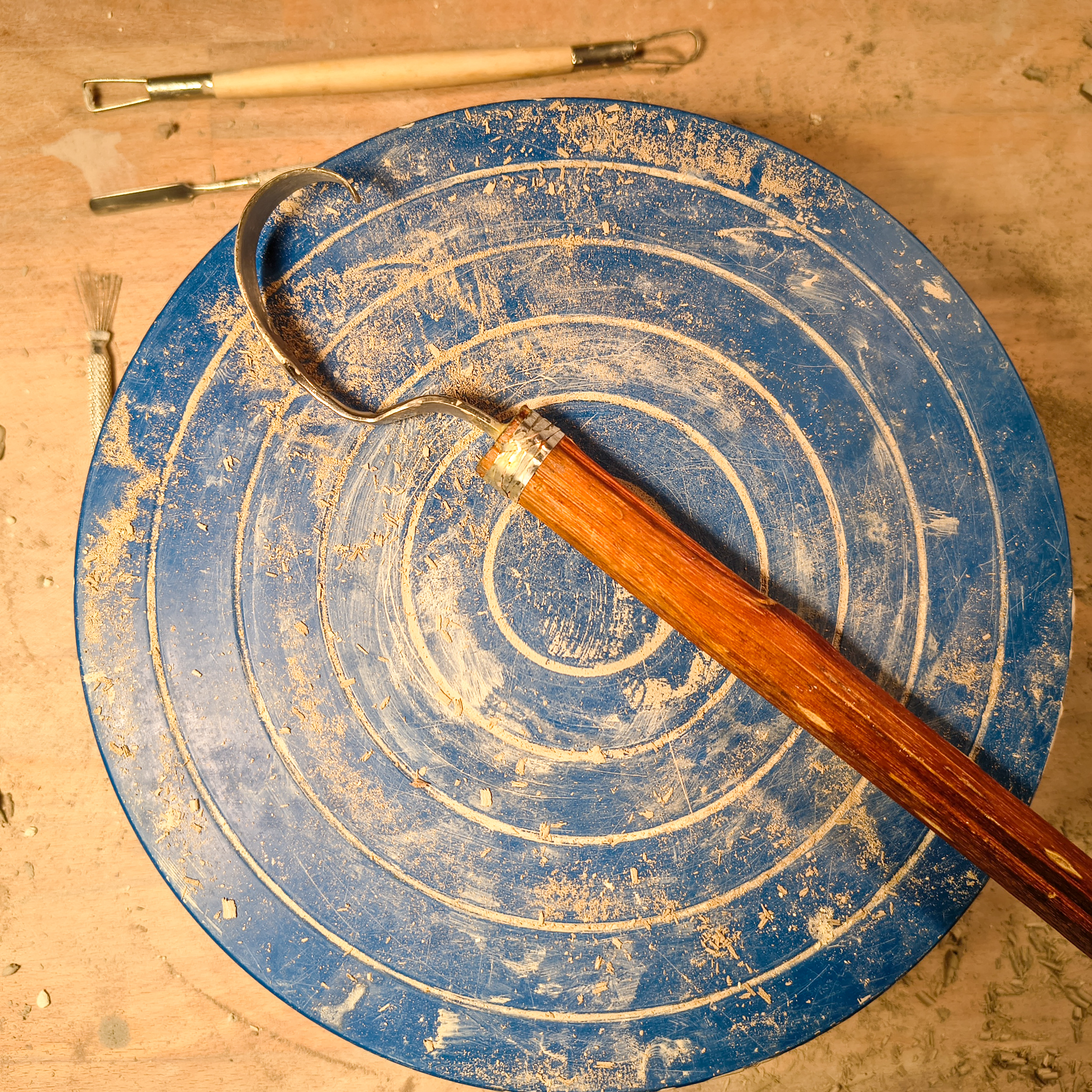
Well, from time to time I improvise tools that make my work easier. Today I’ll show you my tool for scraping material versus on the inside of cups.
You can easily recreate it. You need:
- Material:
- Some wood
- A large serving spoon
- Metal band or metal sleeve
- Tools:
- Saw (wood and metal)
- Drill
- Multi-tool with cutting disc and grinding stone
- Pliers
- Vise
- Adhesive
I chose blackberry as the handle material. Blackberry vines are very suitable. They are very light and yet very stable after drying. Their surface is textured and therefore easy to grip.
Important: In this case, the thorns must first be removed so that you do not injure yourself. Briefly work on the last unpleasant edges with fine sandpaper.

The wood of your choice is brought to the desired length. Take this opportunity to take a close look at the handle: What shape does the handle have, what do you want to do with it and where do you make the cuts?
Draw the shape of your tool on the back of the bowl. Here, too, you should think about the later shape and function.
Now you can, of course with protection for your hands and eyes, clamp the spoon and start sawing.
If the shape of the blade is to your satisfaction, bending follows. A vise is helpful.
Please work carefully and with blunt tools. Stainless steel is tough. If you slip, there is a risk of injury.
To protect the surface, you can clamp your blade between chamois leather. This avoids scratches. Bend in small steps so that the result is even.
Now drill into the handle – in my case: into the dried blackberry vine. Depth and diameter depend on the spoon handle.
Fill the hole with an adhesive that is suitable for metal and wood and becomes very strong. You can roughen the handle of the spoon with a file so that the adhesive adheres better. Distribute the adhesive well and push the handle on well so that the adhesive reaches all the way to the bottom, wets everything and is free of bubbles. You can also coat the degreased metal handle with adhesive before driving it into the hole in the handle.
When the adhesive has hardened after a few days, sharpen the edges of your tool as you need it. Something as a surface, rectangular surface, if you want to scrape, or as a cutting edge.
Depending on the type of wood, it is worth reinforcing the end of the handle on the blade side with a metal ring or metal band so that it does not break out.
Done. You have made your own tool – and certainly not the last.
Other tools
Tools that are good for DIY are those that should definitely leave their mark. Think of Kurinuki as an example, where they would even be particularly effective.
Advanced users can also deform metal.
If you want to try this, you have to be extremely careful. The workpiece may become red-hot and many hundreds of °C hot.
With a welding flame or the like, you can then deform jigsaw or hacksaw blades.
You can then insert the result into a handle.

Leave a Reply