


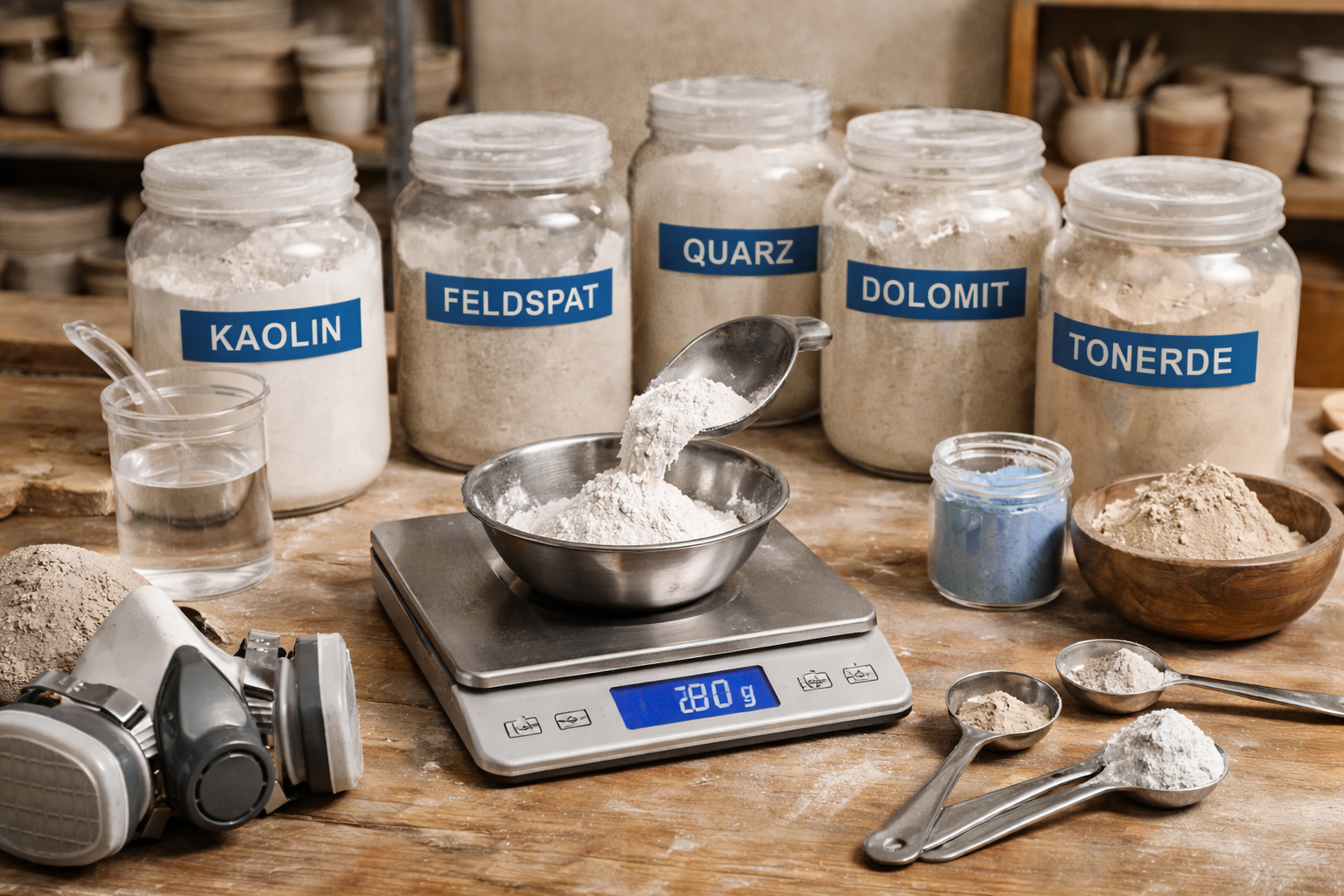
Preliminary note
I will develop this page bit by bit. I simply don’t have the time for anything else.
So as long as this note is here, the page is not yet finished.
What are glaze ingredients?
Glazes are, as the name suggests, melts that have solidified into glass. Glass is an amorphous solid (a supercooled melt that has no ordered, crystalline structure).
To make that work—ideally at temperatures we can produce and control—different types of ingredients are needed.
In addition, the glaze usually needs decorative properties as well, which typically requires further ingredients.
One possible classification is:
- Glass formers
This is the “matrix,” the material in which everything else is embedded and which solidifies amorphously through relatively rapid cooling.
By far the most common is SiO2. - Glass modifiers
In English, it is also referred to as “refractory” because it has enormously high melting temperatures on its own.
The usual agent is Al2O3. - Fluxes
The flux or fluxes, in interaction with the other ingredients, provide a melting temperature range that falls within a technically manageable level. Without these, we could only sinter ingredients together, and a bond with the ceramic body would hardly be possible.
These are primarily alkali metal oxides and alkaline earth metal oxides. - Coloring oxides / Effect formers
We can add further oxides to the melt, which are responsible for colors, patterns, crystals, opacification, bubbling, etc., in a complex interplay within oxygen-rich and oxygen-poor atmospheres.
Classification
Our ingredients are all oxides, and they can be classified according to their structure.
- RO2: Glass Formers
- R2O3: Glass Modifiers
- R2O and RO: Fluxes
Here, “R” stands for an element, for example, aluminum, silicon, potassium, etc.
And of course, there are plenty of exceptions. For example, iron oxide, which has the structure of a modifier as Fe2O3, is typically used for brown and yellow colorations, but also acts as a flux from 2-3% glaze content.
Sources of Glaze Ingredients
First of all, you can buy all the ingredients.
This is often the cleanest and safest way. Especially at the beginning, I advise you to do so, because a material analysis of “wild” glaze ingredients is not available to you.
However, if you want to make your own glaze ingredients, you only need to bend down.
Practically anything that can be pulverized is suitable – more or less.
What lies in the earth is usually already present in oxidized form.
Everything else you probably have to burn first and obtain ash.
However, keep in mind that the resulting materials are often irritating and, as dust, can also get into the lungs. Please inform yourself thoroughly about risks and suitable measures beforehand.
Furthermore, you will have to work batch-wise, because one ingredient will never truly be the same as another – even if you obtained it from materials from the exact same place. But that’s part of the charm, isn’t it?
Obtaining Ash
For example, if you burn hay, straw, leaves, wood, etc., a part of it volatilizes as gas: the “LOI” – “Loss on Ignition.”
What remains, the ash, is a mixture of different minerals and thus oxides.
In fact, these ashes can have very different compositions.
Rice husk ash, for example, consists almost entirely (>95%) of very fine SiO2 and provides the framework of a glaze. Beech wood ash, if washed, consists predominantly of MgO and CaO and a little K2O and serves as a flux.
It’s worth researching here. The composition changes with its origin – but as a rule of thumb, it’s better than guessing and cheaper than a lab.
Washing
Washing ingredients sounds absurd. But it makes sense.
Let’s take ash, for example. It will also contain salts. The same applies to ingredients from the sea. These, of course, produce special effects – but they are also extremely aggressive and destroy heating coils in electric kilns and are very unhealthy.
Feel free to wash your ingredients.
You must (!!) mix them wet for sieving anyway, then you can rinse them more often at the same time. This way you can also remove carbon residues and other suspended solids. When the wash water remains clear, the ash is clean.
Grinding and Calcining
If you don’t have the luxury of a ball mill, the mortar (granite, agate, or other hard materials) is your friend.
Grinding is always done wet so that no dust can rise.
For stones, it is advisable to calcine them beforehand. Calcining involves heating raw materials to around 900°C. This changes the structure, volatile components such as crystal water or CO2 are released, the material becomes brittle and largely disintegrates on its own.
Grinding is then much easier, and the obtained ingredients are less prone to blistering during glaze firing because volatile substances have already been released.
Table values
Ash analyses1
| SiO2 | Al2O3 | Fe2O3 | CaO | MgO | K2O | Na2O | P2O5 | SO3 | Cl | MnO | |
|---|---|---|---|---|---|---|---|---|---|---|---|
| Apple wood | 2,7 | 70,9 | 5,5 | 11,8 | 1,9 | 4,5 | 2,7 | ||||
| Apple wood, washed | 2,7 | 2,0 | 0,7 | 54,2 | 3,3 | 0,9 | 1,6 | ||||
| Maple wood | 13,8 | 0,7 | 2,4 | 28,4 | 11,6 | 6,3 | 6,4 | 7,1 | 1,2 | 0,7 | 0,4 |
| Birch wood | 11,5 | 1,3 | 29,6 | 14,3 | 22,6 | 9 | 7,9 | 2 | 1 | 0,3 | |
| Beech wood | 3,9 | 0,6 | 42,0 | 8,2 | 24,3 | 8,3 | 6,2 | 2,1 | 0,7 | 4,5 | |
| Beech wood | 5,4 | 56,4 | 10,9 | 16,4 | 3,6 | 5,4 | 1,8 | ||||
| Beech leaves | 33,8 | 44,9 | 5,9 | 5,2 | 0,7 | 4,7 | 3,6 | ||||
| Boxwood | 12,6 | 1,1 | 30,1 | 14,0 | 19,8 | 8,3 | 7,1 | 2,5 | 1,2 | 0,3 | |
| Oak wood | 2,0 | 72,5 | 3,9 | 9,5 | 3,9 | 5,8 | 2,0 | ||||
| Oak wood | 15,3 | 0,1 | 2,4 | 30,0 | 12,0 | 14,0 | 9,1 | 13,1 | 2,6 | 1,2 | 0,1 |
| Oak wood | 4,0 | 5,5 | 0,7 | 49,0 | 3,0 | 1,5 | 0,2 | 3,0 | 1,7 | ||
| Oak bark | 3,3 | 1,7 | 56,7 | 7,5 | 25,8 | 1,7 | 2,5 | 1,7 | |||
| Ash wood | 23,3 | 0,6 | 3,9 | 25,5 | 12,0 | 16,0 | 7,7 | 7,0 | 2,5 | 1,0 | 0,4 |
| Ivy | 11,4 | 0,1 | 2,5 | 24,6 | 8,0 | 25,5 | 20,1 | 5,6 | 1,0 | 0,6 | 0,5 |
| Fern | 6,1 | 14,1 | 7,6 | 42,8 | 4,6 | 9,7 | 5,1 | 10,2 | |||
| Fern, washed | 40,4 | 11,9 | 0,7 | 20,6 | 10,9 | 2,4 | 4,4 | ||||
| Spruce wood | 1,8 | 0,2 | 29,6 | 5,5 | 7,4 | 5,5 | 3,7 | 1,8 | 42,6 | ||
| Spruce needles | 3,1 | 6,9 | 23,5 | 6,6 | 29,6 | 0,5 | 18,4 | 4,6 | |||
| Barley straw | 53,8 | 7,5 | 2,5 | 21,2 | 4,6 | 4,3 | 3,6 | 0,3 | |||
| Grass ash, washed | 76,0 | 5,4 | 1,1 | 6,1 | 3,7 | 2,5 | 0,2 | 1,6 | 0,2 | 0,7 | |
| Laburnum | 26,1 | 0,4 | 3,0 | 29,4 | 2,2 | 16,0 | 4,6 | 12,7 | 3,9 | 1,0 | 0,5 |
| Oat straw | 46,7 | 1,1 | 7,0 | 3,9 | 28,9 | 3,3 | 4,6 | 3,2 | 4,4 | ||
| Hazelnut wood | 9,7 | 0,1 | 0,1 | 26,6 | 15,2 | 36,2 | 10,2 | 4,2 | 1,0 | 0,6 | 0,1 |
| Heather | 35,2 | 4,0 | 16,2 | 8,9 | 7,6 | 9,4 | 4,2 | 11,1 | 2,1 | ||
| Heather | 32,2 | 18,8 | 8,3 | 13,3 | 5,3 | 5,0 | 4,4 | 2,2 | |||
| Autumn leaves, mixed | 56,5 | 4,3 | 1,2 | 18,1 | 5,3 | 2,7 | 2,6 | 1,1 | |||
| Hearth ash (Japan) | 31,0 | 8,9 | 3,0 | 22,4 | 3,3 | 3,9 | 2,3 | 1,9 | 1,3 | ||
| Hearth ash (Japan) | 14,1 | 3,7 | 0,9 | 35,9 | 5,4 | 1,5 | 0,6 | 2,1 | 0,1 | ||
| Elder | 12,8 | 0,4 | 35,9 | 15,6 | 15,6 | 1,2 | 12,1 | 5,8 | 0,3 | 0,09 | |
| Holly | 21,7 | 0,4 | 2,6 | 13,6 | 15,4 | 16,4 | 12,1 | 11,4 | 2,0 | 1,9 | 0,4 |
| Chestnut | 12,8 | 3,9 | 32,0 | 16,5 | 27,8 | 10,6 | 2,3 | 3,1 | 1,1 | 0,8 | |
| Sweet flag | 31,4 | 5,9 | 4,2 | 33,2 | 7,3 | 6,7 | 8,3 | 5,6 | |||
| Pine | 10,0 | 0,4 | 4,0 | 25,0 | 6,3 | 26,5 | 8,6 | 8,9 | 4,6 | 0,5 | 5,1 |
| Pine (Japan) | 24,4 | 9,7 | 3,4 | 39,7 | 4,5 | 9,0 | 3,8 | 2,8 | 2,7 | ||
| Cherry wood | 24,9 | 2,6 | 30,2 | 8,7 | 21,6 | 1,8 | 7,6 | 2,6 | 8,8 | ||
| Bone ash | 2,9 | 0,3 | 52,4 | 13 | 40,9 | ||||||
- This table was compiled by Wolf Matthes in “Ceramic Glazes” from works by Besborodov, Cardew, Cooper, Frére Daniel, Leach, Sanders, Wolff. [↩]