



“You’re walking through the park in the dark with your sweetheart. Suddenly, a stranger jumps out of the bushes. An hour later, you’re lying dead in your apartment. Who was it?”
Podcast
I have a lot of time while I’m in the car. The A45 is merciful and grants me slowness.
That’s why I’ve been listening to podcasts for a few months now.
My favorites at the moment are “Understanding AI” (Deutschlandfunk), “Current Research” (Deutschlandfunk), and a random find, “Supervised Feeling” (Dr. Leon Windscheid and Atze Schröder—though Dr. Windscheid isn’t a medical doctor…).
The riddle at the beginning comes from the latter.
And that’s also where a few numbers come from that made me curious.
I looked up the numbers again specifically and prepared them for you.
The solution to the riddle is probably not much of a surprise anymore.
The numbers
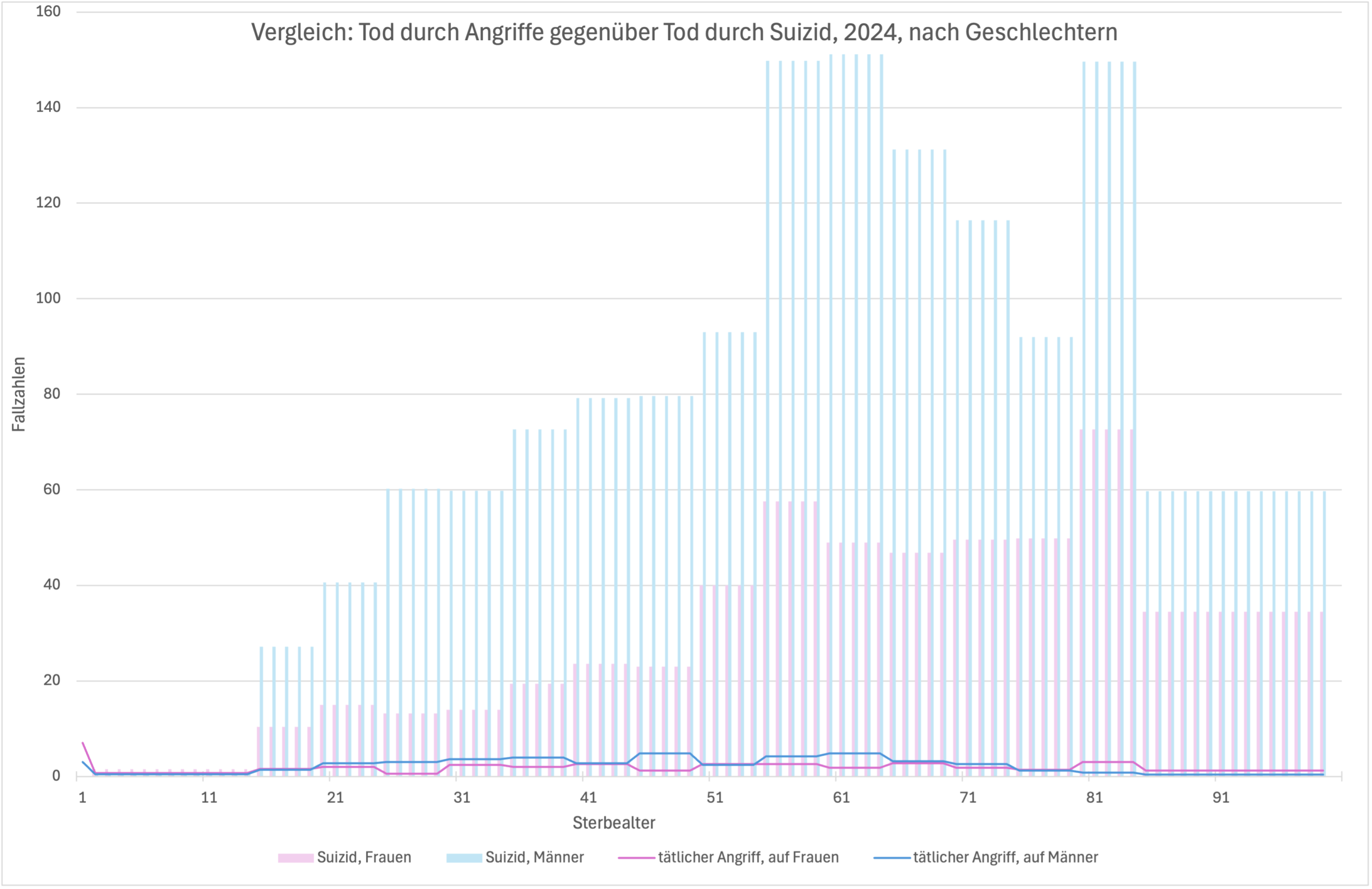
The first number that made me sit up and take notice: You are 14x (!!) more likely to die by your own hand than by the violence of others.
Not true. In 2024, it’s more like 25x. At least according to the data from Destatis.
In total, over 1,000,0001 deaths are reported for 2024. And with 400 cases, physical assaults are almost at the very bottom of the statistics.
What was the podcast episode about?
It was about fear. Specifically, what purpose fear served in our evolution and where it finds an outlet today. Or rather: where it has to find an outlet now, in the absence of bears, tigers, and wolves.
Fear of…?
Anyone who didn’t say “the partner” for the riddle at the beginning probably said “the stranger from the bushes.”
The former, because as a motive-driven act, it’s part of the evening news or media reports—making it a very prominent fear.
The latter, because in the past, the fear of the unknown and of surprises kept us alive.
And so today, we are still afraid of what we are taught to fear and what we don’t know. See “prejudice.”
The idea that we put ourselves in danger, that we are even the danger ourselves, is a thought and a feeling that is rather foreign to us.
Staying level-headed
By now at the latest, I’ve moved beyond the scope of the podcast that inspired me to write this.
There are so many real threats in our lives.
We have a brain that has been “modern” for 300,000 years (or so). And we are now surrounded by dangers that this brain was not built for and is not used to grasping.
Our bears, wolves, and tigers are now called illness, climate, resources, uncertainty (e.g., whether we find or keep a job), and stress in every form.
When the brain can neither flee nor fight, it’s simply at its wit’s end. The brain as such wants to adapt—but it probably can’t work miracles either.
That’s where, I think, what can become a mental illness begins.
Burnout syndrome, depression of all kinds & the like have now become widespread conditions that people don’t talk about.
Others, after all, also claim they manage.2
Be that as it may. Our evolutionary fear probably has to find its way somewhere and warn us about something. But when fear shouts, “There! Him! Danger!”… Well. We have to stay level-headed.
At this point, we must remain “civilized.”
Civilization
We are not animals in the true sense. (Yes, we are. But at least we like to claim that we aren’t.)
An archaeologist whose name I no longer remember once said that the cradle of civilization was the first healed broken leg.
The first time a human, surrounded by wilderness, healed another human.
The first time there was a sense of “being there for one another.”
All of this, I fear, is perhaps perishing in a present that, driven by high-pressure and short-circuit fears, is withdrawing further and further into itself and away from others.
And yes: that too is a fear that is perhaps just making space for itself, fearing an unknown tomorrow that is simply different from today.
And now?
I must have written all this to help with a totally simple answer at the end, right?
Nope. Sorry.
The answer to the riddle from the beginning is: “You yourself.” So please take very good care of yourself. You are important and irreplaceable.
“The answer to life, the universe, and everything” is still 42.
And the answer to all these words is: You are afraid. I am afraid. Everyone is afraid. That’s not a bad thing—if we allow reason and emotion to coexist as equals within us.
I think where reason is not enough, we should feel.
And where feelings make us irrational, we must give reason a chance.
(While restoring my crashed website, I updated the numbers in this post from 2022 to 2024.)

Leave a Reply